
“Minor to Whom?” – The Invisible Agony of Neurotic Disorders
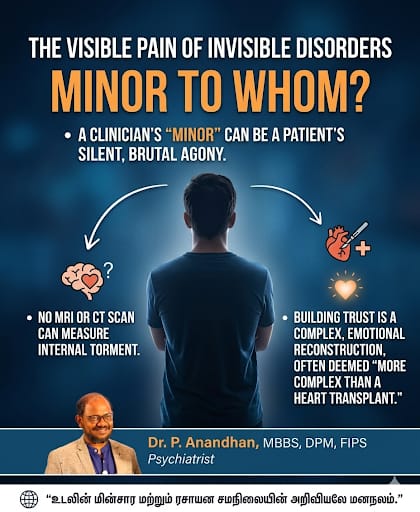
In psychiatry, we often categorize conditions as “Major” or “Minor.” But we must stop and ask a critical question: Minor to whom?
To a clinician, a case of anxiety or depression might appear “minor” compared to a complex psychotic disorder. But to the individual trapped in the suffocating grip of severe anxiety, depression, or psychosomatic pain, the suffering is anything but minor.
The Unseen Struggle
These individuals endure a silent, brutal agony that only they can feel. Unlike a physical injury or a visible tumor, this pain is invisible to the outside world. No MRI, no CT scan, and no medical expert—no matter how senior—can truly peer inside and measure the depth of their internal torment.
The Challenge of Treatment
Ironically, treating a “major” disorder like Psychosis can often be more straightforward, as it frequently responds to standardized pharmacological protocols. However, treating a “minor” disorder is a monumental challenge. It requires:
- Time and Patience: Spending hours listening to their unspoken fears.
- Deep Empathy: Truly feeling their distress from within.
- Building Trust: Cultivating the profound belief in the patient that “This doctor can save me.”
More Complex than a Heart Transplant
Building this therapeutic alliance and healing a fractured mind is often more complex and demanding than performing a major surgery, like a heart transplant. It is a delicate process of emotional reconstruction.
In my view, labeling these profound human struggles as “minor” is not only a medical oversight—it is a failure to recognize the true weight of human suffering.
– Dr. P. Anandhan, MBBS, DPM, FIPS Psychiatrist